Bryan Johnson investigates psilocybin: What do the initial results reveal?

Bryan Johnson investigates psilocybin: What do the initial results reveal?
Bryan Johnson is an American tech millionaire who has dedicated his life to longevity: living as long and as healthily as possible while trying to slow down biological aging. Through his Blueprint project, he monitors his health down to the smallest detail, from sleep and nutrition to hundreds of biomarkers. Now, he has turned his attention to psilocybin. The initial results surprised him.
What if you could even measure a psychedelic experience?
Bryan Johnson is known for his radical approach to health and longevity. Through his Blueprint project, he aims to slow down biological aging using extensive measurements, a strict lifestyle protocol, and science-based interventions. From sleep and nutrition to physical performance, almost everything is measured, analyzed, and optimized. Now, he’s turning that same curiosity toward psilocybin, the psychoactive compound found in Fungki’s truffles.
Together with his team, he launched an experiment to explore the potential effects of psilocybin on his body and brain. His broader health protocol tracks 249 biomarkers.
His first conclusion? “The early results surprised us.”
249 biomarkers: three remarkable findings
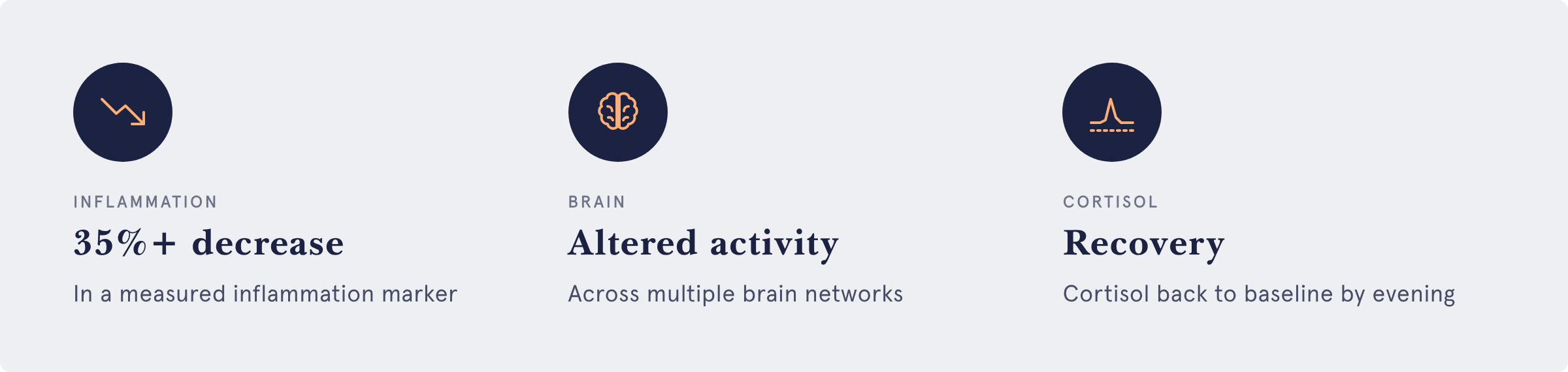
For this experiment, Johnson focused on three particularly interesting areas: inflammation, brain activity, and cortisol, the hormone that plays an important role in our body’s stress response.
1. Inflammation: a decrease of more than 35%
Following his psilocybin experience, Johnson reported a decrease of more than 35% in his measured systemic inflammation levels. According to Johnson, the levels even dropped below the detection threshold. A remarkable finding, especially considering that chronic inflammation is a major area of research in longevity and healthy aging.
At the same time, it’s important to interpret these results with caution. These measurements come from just one person, meaning they don’t prove that psilocybin reduces inflammation in the long term or that psilocybin was directly responsible for the decrease. Nevertheless, it’s an interesting observation that may contribute to ongoing research, particularly as the potential relationship between psilocybin and inflammation continues to be explored.
2. The brain: less control, more flexibility?
Johnson had his brain activity monitored during his psychedelic experience. His team observed changes in several regions, including the prefrontal and premotor cortex. They also identified changes in brain activity patterns in areas involved in sensory processing, hearing, and speech.
His team described the observed brain patterns as more open, flexible, and less predictable. According to Johnson, some patterns even appeared more youthful rather than rigid or associated with aging.
An interesting observation, especially as researchers have been studying how psilocybin can temporarily alter communication between different brain networks.
3. Cortisol: a temporary stress response
During the peak of his experience, Johnson’s cortisol levels increased significantly. This isn’t unusual: research shows that psilocybin can cause a temporary rise in this stress hormone. Interestingly, his cortisol levels returned to baseline later that evening. According to Johnson, this suggests a temporary physiological response, without persistently elevated cortisol levels on the day of the experiment. However, this doesn’t automatically mean that psilocybin reduces stress or that such an experience is risk-free for everyone. It primarily provides insight into how his body responded during and after this particular experience.
The experience behind the numbers
Perhaps the most fascinating part of his experiment wasn’t what the equipment measured, but what Johnson experienced himself. He described how ordinary, everyday things suddenly felt extraordinary. Music sounded more intense, touch took on a whole new dimension, and even a simple glass of water filled him with wonder. Afterwards, he claimed to have enjoyed a simple salad more than ever before. The experience brought back a childlike sense of wonder:
“I felt like a kid finding and exploring a new playground.” — Bryan Johnson
What can we learn from this?
Perhaps the most interesting aspect of Johnson’s experiment isn’t just the results, but his approach. He explores psilocybin with curiosity, careful preparation, and close attention to what happens in his body and mind. By combining measurable data with his personal experiences, he aims to better understand what takes place during a psychedelic experience.
At the same time, he acknowledges the limitations of his findings. His experiment took place under medical supervision, in a legal setting, and with the support of a professional guide. The results are exploratory and based on his own body and experience. This means they don’t provide conclusive evidence that psilocybin slows aging, reduces inflammation, or leads to lasting improvements in brain function. However, they do contribute to an interesting conversation about the relationship between psilocybin, the brain, and the body.
And what does this mean for microdosing?
At Fungki, we follow developments in psilocybin research with great interest. Not because one experiment provides all the answers, but precisely because there is still so much left to discover. There is, however, an important distinction. Bryan Johnson explored high, psychedelic doses of psilocybin under medical supervision. Microdosing, on the other hand, involves much smaller doses that are not intended to produce a full psychedelic experience.
What inspires us about Johnson’s approach is his curiosity. His willingness to explore new possibilities, remain critical, and pay attention to the connection between body and mind. That reflects how we approach psilocybin at Fungki: with respect, knowledge, and without exaggerated promises.
Curious about microdosing?
Wondering how microdosing relates to this kind of research? Discover what microdosing actually is, what science has to say about it, and why a mindful and responsible approach matters.
Discover microdosing at Fungki
Source and disclaimer
This article is based on Bryan Johnson’s publicly available blog Magic Mushroom Biomarker Results van Bryan Johnson published on February 9, 2026. Fungki is not affiliated with Bryan Johnson or Blueprint. The findings described are based on a personal experiment involving high doses of psilocybin under medical supervision. The results are exploratory and cannot be directly applied to microdosing. This article is for informational purposes only and does not constitute medical advice. Psilocybin carries risks and is not suitable for everyone.