Mental performance: why your mind can handle more than you think


Mental performance: why your mind can handle more than you think
You know the feeling. You’re sitting at your desk, your to-do list keeps growing, but your mind just won’t cooperate. Focus slips away. The energy is there, but never quite when you need it. Creativity? Somewhere. But not here, not now. Mental performance isn’t a talent. It’s something you can train, support and improve — as long as you understand what’s actually happening in your brain. At Fungki, that’s exactly what we focus on: how to strengthen your mental capacity in a natural, well-informed way. Not with quick fixes. Not with hype. But with knowledge, structure and the right support.
What do we mean by mental performance?
Mental performance is about four core areas that together determine how you function:
- Focus. How long, and how sharply, can you hold your attention? For people with ADHD, this can be a daily challenge. For others, it is often subtle mental fatigue that slowly eats away at their focus.
- Energy levels. Not just physical energy, but cognitive energy: the capacity to think clearly, make decisions and be fully present. When you are mentally drained, you feel it in everything.
- Creativity. The ability to make new connections, see solutions others might miss and think beyond the obvious. Creativity is not a luxury; it is a skill you can support and strengthen.
- Mood and resilience. How do you deal with setbacks? How quickly do you recover? Low mood and depressive feelings can directly influence how you perform, think and learn.
These four areas are deeply connected. Improve one, and the others often benefit too.
Psilocybin: what science says
Psilocybin is the active compound found in truffles and magic mushrooms. In higher doses, it can produce a psychedelic experience. But in low, sub-perceptual doses — what we call microdosing — it works differently. With psilocybin microdosing, you take an amount that you do not “feel” in the classic sense. No hallucinations. No feeling switched off. What many people do report are subtle changes such as improved focus, a better mood, increased energy levels and a fresher perspective on things.
Research into psilocybin as a potential treatment for depression is growing rapidly. Studies from institutions such as Johns Hopkins and Imperial College London suggest that psilocybin may have significant effects on persistent depressive symptoms, including in cases where conventional antidepressants have not been effective. This makes psilocybin and depression one of the most active areas of research in psychiatry today.
So what makes psilocybin so interesting? It appears to influence the brain’s default mode network: the network that becomes active when you are not focused on a specific task, and is often linked to overthinking, brooding and rumination. In depression, this network can become overactive. Psilocybin seems to help disrupt that pattern, creating space for new ways of thinking to emerge.
Important: psilocybin is not a miracle cure. It appears to work best in the right context, with the right support.
Microdosing: how does it work in practice?
Microdosing means taking a very small amount of psilocybin truffles, typically 0.1 to 0.2 grams, according to a fixed schedule. The best-known protocol is the Fadiman protocol, developed by psychedelic researcher James Fadiman. The Fadiman protocol works as follows: one day on, two days off. At Fungki, this is our beginner protocol, because we recommend everyone starts here. The rest days help prevent the body from building tolerance, which helps keep the effect more consistent. Many people start with this protocol, build experience and later adjust the schedule based on what works for them. Microdosing experiences vary from person to person. Some describe feeling more calm and clear-headed, while others mention increased productivity or improved sleep patterns. People with ADHD sometimes report less impulsivity and a calmer internal monologue.
Microdosing and ADHD is a topic that is receiving more and more attention, although scientific research is still catching up with real-world experiences. What is clear, however, is that microdosing is not a replacement for professional help in cases of serious mental health concerns. It is a complementary tool, and is most effective when used as part of a broader approach.
Lion’s mane: the mushroom that supports your brain
Alongside psilocybin truffles, Lion’s Mane is one of the most researched natural ingredients for mental performance. Lion’s Mane, also known as Hericium erinaceus, is a functional mushroom with an impressive profile. Its active compounds, hericenones and erinacines, are associated with the production of NGF: Nerve Growth Factor. This is a protein that supports the growth, maintenance and repair of nerve cells. Simply put: Lion’s Mane may help support the brain’s natural ability to maintain and renew itself.
Research points to potential benefits for focus, memory and the reduction of anxiety and low mood symptoms. There is also growing interest in the role Lion’s Mane may play in neurodegenerative conditions, although this research is still in its early stages. For people working on mental performance, Lion’s Mane is a logical building block. The clearest effects are usually seen with consistent use over several weeks, especially when used alongside a structured microdosing protocol.
Psychedelic-assisted therapy: a new direction in mental healthcare
Psychedelic-assisted therapy is no longer a fringe movement. It is a serious and rapidly growing field within psychology and psychiatry. Countries such as the United States, Canada, Australia and the Netherlands are at the forefront of both research and policy. What sets psychedelic-assisted therapy apart from other forms of treatment is the combination of a psychedelic session with professional support before, during and after the experience.Within this context, psilocybin sessions are being explored for depression, PTSD, addiction and existential distress in terminally ill patients. The results in clinical studies are promising. Not guaranteed, and not for everyone, but significant enough for mainstream psychiatric institutions to take increasing interest.
In the Netherlands, truffles are legal. This makes the use of psilocybin truffles in controlled settings possible. A psilocybin session should always involve proper preparation, a safe environment and integration afterwards.
Depression and alternative routes
Depression is one of the most common mental health conditions in the world. Depressive symptoms can range from a persistent low mood and lack of energy to a loss of interest in things you would normally enjoy. The symptoms of depression are broad and often overlap with other concerns, which can sometimes make them difficult to recognise. Conventional antidepressants help many people. But for a significant group, they are not effective enough, or they come with side effects that can be difficult to manage. As a result, interest in natural antidepressants is growing. Lion’s Mane, certain adaptogens, movement, sleep hygiene and microdosing are increasingly being explored as a complement to, or alternative route alongside, conventional medication-based treatment.
The phrase “new antidepressants” partly reflects this shift: interest in non-classical approaches is increasing, including within mainstream medicine. What helps with depression differs from person to person. At Fungki, we believe in an approach that works for you, based on knowledge rather than hype. Are you unsure whether microdosing or psilocybin is right for you? Always speak to a doctor or therapist first.
Buying truffles: what should you look for?
If you want to buy microdosing truffles, or order truffles for personal use, there are a few important things to keep in mind.
- Quality is everything. Truffles that are poorly produced or stored can be less effective and less reliable in terms of dosage. Always buy from a trusted provider that is transparent about origin, variety and dosage.
- The variety matters. Psilocybe mexicana is one of the most commonly used varieties for microdosing, thanks to its mild and easy-to-dose profile. Mexicana truffles are accessible for beginners and widely available. Other varieties, such as Mokum and Atlantis, are stronger and less suitable for microdosing.
- Dosage. With microdosing, the dose should stay low: typically 0.5 to a maximum of 2 grams of fresh truffles, or a standardised microdose in dry weight.
- Guidance. Especially if you are new to microdosing, a microdosing coach or a good microdosing guide can be valuable. Not because you necessarily need one, but because it can deepen the experience and help you avoid common pitfalls. That is why a beginner microdosing protocol is always worth considering.
How Fungki does things differently
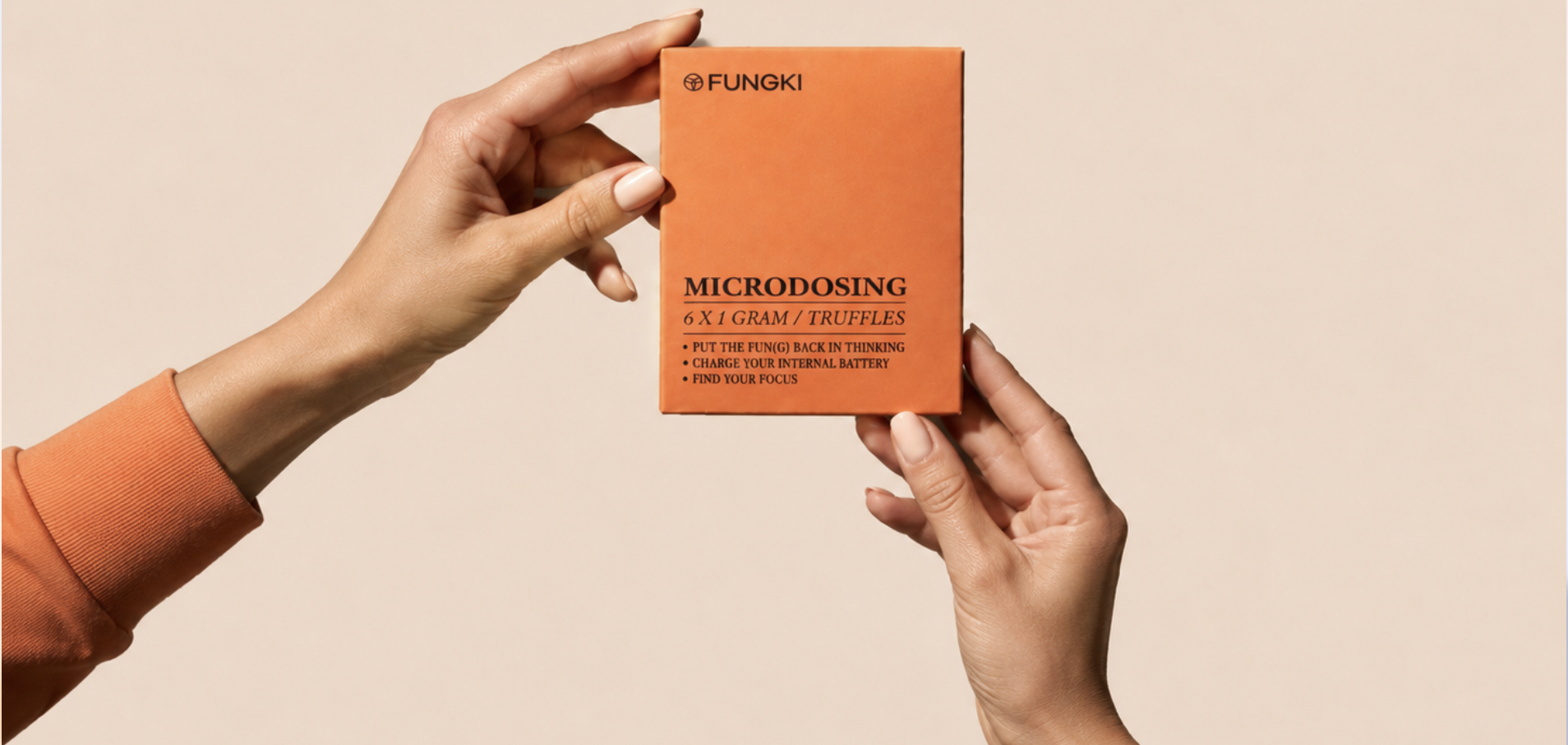
There are many providers of truffles and microdosing products. What sets Fungki apart is our focus on the bigger goal: your mental performance, not just the transaction. That means that with Fungki, you do not just find products. You find knowledge, context and guidance. Information about the Fadiman protocol, how microdosing works, Lion’s Mane and psychedelic-assisted therapy. Access to a microdosing coach if you want one. And products specifically developed for microdosing. Our truffles, for example, are much smaller than standard truffles. They keep their full outer layer, are easy to swallow and are virtually tasteless and odourless. We tell you all about it in this blog.
Mental performance is a long-term investment. It is about getting the most out of yourself when you want to. The best part: we help you train it, so you can maintain the level you build.
Practical steps if you want to start
Are you new to microdosing and wondering whether it could be right for you? Start here:
- Read up. Good literature on microdosing gives you an honest understanding of what it is, what it can do and what it is not. Tip: read Fungki’s beginner diaries. They give you a helpful sense of what people experience and how they approach it.
- Define your goal. Do you want more focus? Better stress management? Support with low mood? Your goal helps determine which approach fits you best.
- Speak to a professional. Especially if you are already taking medication, experience depressive symptoms or have a history of mental health vulnerability, it is wise to discuss this with a doctor or therapist first.
- Start low, go slow. Microdosing requires patience. The effects are subtle and cumulative. Give yourself at least three to eight weeks to get a fair impression. That is why we designed the beginner protocol, including guidance by email, so you do not have to figure it all out alone.
- Track what you notice. A journal, even a simple one, can help you recognise patterns in your mood, focus and energy.
Mental performance is not an endpoint. It is an ongoing process of attention, knowledge and the willingness to invest in how you think, feel and function. Fungki is here to support you in that process.
Disclaimer: the information in this article is educational in nature and does not replace professional medical or psychiatric advice. If you are experiencing serious mental health concerns, including depression, always consult a doctor or mental health professional.