Microdosing for entrepreneurs: what does the science really say?

Microdosing for entrepreneurs: what does the science really say?
You wake up with an idea. During your workout, you’re thinking about your next project. And when you finally find a moment to relax, your mind is already on tomorrow. Entrepreneurship gives you freedom, but it also comes with a mind that rarely switches off. No wonder more founders are becoming curious about microdosing. Not as a shortcut to success, but as a question: what’s possible, and what does the evidence actually say?
The short answer: microdosing involves taking a small amount of psilocybin or another psychedelic substance, without aiming for a full psychedelic trip. Many entrepreneurs are drawn to it because of stories about creativity, focus and resilience to stress. Animal studies have shown some interesting findings, but so far, there is no convincing evidence in humans that microdosing makes you more creative, sharper or more productive. If you’re curious about experimenting, it pays to stay both open-minded and critical.
In this article, you’ll discover:
- What microdosing actually is;
- Why it appeals to entrepreneurs;
- What science says about stress, creativity and focus;
- Who should avoid microdosing.
What is microdosing?
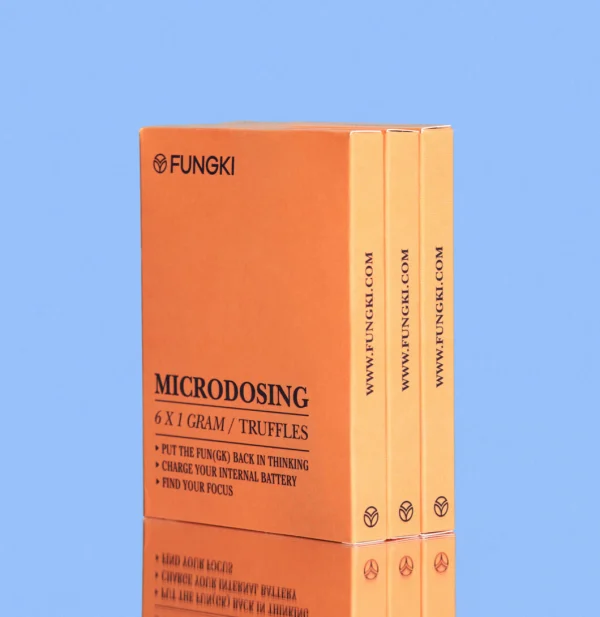
Microdosing means taking a very small amount of a psychedelic substance, such as psilocybin, without aiming for a full psychedelic experience. The dose is intended to be low enough for you to continue functioning in everyday life. Psilocybin is the active compound found in psychedelic mushrooms and truffles. At Fungki, we work with psilocybin truffles, which are legally available in the Netherlands.
Want to start with the basics? Learn what microdosing is and how it works.
Why are entrepreneurs interested in microdosing?
Entrepreneurs are constantly investing. In their businesses, networks, knowledge and health. Increasingly, that curiosity also extends to their own minds. How do I make decisions? How do I handle pressure? And how do I create space for new ideas? You spend your days switching between big ambitions and small details. You need to think creatively when things get stuck and make decisions without having all the answers. That takes more than knowledge and discipline. It also takes self-awareness.
In personal accounts of microdosing, the same themes often come up:
- Creativity: seeing new connections and thinking beyond familiar patterns.
- Focus: maintaining attention when facing a difficult decision.
- Mood and stress: navigating the uncertainty that comes with entrepreneurship.
- Self-reflection: becoming more aware of your own behaviour and habits.
One important distinction: feeling more creative or mentally sharp doesn’t automatically mean microdosing is responsible.
From Silicon Valley to a wider curiosity
Around 2015, microdosing began attracting significant media attention in Silicon Valley. Rolling Stone reported on tech professionals experimenting with small doses of LSD. One of them described how it helped him explore new designs and ways of thinking. In 2016, WIRED spoke with professionals in technology and science about their personal experiences.
Two important points are worth keeping in mind:
- These stories were mainly about LSD. Fungki works with psilocybin. They are different substances, and experiences with one cannot automatically be applied to the other.
- Personal experiences are not scientific proof that microdosing improves creativity or productivity.
Still, these stories help explain why microdosing gained attention in an environment built around experimentation, innovation and challenging conventional thinking.
What does science say about microdosing?
In short, animal research has produced some interesting findings, but evidence in humans for improved creativity or focus remains limited and inconsistent.
- Kiilerich et al. (2023), Molecular Psychiatry
Subjects: Rats
Method: Repeated low doses of psilocybin
Findings: Increased stress-resilient behaviour, reduced repetitive behaviour and stronger connections to the thalamus. - Szigeti et al. (2021), eLife
Subjects: Humans, self-blinding study
Method: Microdosing compared with placebo, measuring well-being and cognition
Findings: Improvements were reported, but were comparable to those seen with placebo. - Cavanna et al. (2022), Translational Psychiatry
Subjects: Humans, double-blind study
Method: Psilocybin microdosing and its effects on creativity and cognition
Findings: No measurable improvement compared with placebo.
Stress and microdosing: what have researchers observed in rats?
In 2023, researchers led by Kat F. Kiilerich investigated what happens when rats receive repeated low doses of psilocybin. They observed:
- Behaviour suggesting greater resilience to stress;
- Reduced grooming behaviour, used in rats as a measure of certain repetitive behaviours;
- Increased density of synaptic connections in part of the thalamus, a brain region involved in processing signals.
These findings are interesting because the study examined repeated low doses rather than a single high dose. However, the research was conducted in rats. Behaviour observed in an animal experiment is not the same as the complex stress entrepreneurs experience in everyday life. The study offers a reason for scientists to investigate further. It does not prove that microdosing helps people cope with work-related stress.
Microdosing, creativity and focus: what do we know about humans?
For entrepreneurs, these are probably the most interesting questions. Yet research in humans has not consistently demonstrated that microdosing improves creativity, concentration or cognitive performance. Some studies report changes in subjective experiences or brain activity. Others find little or no difference compared with a placebo. Expectations can also play a significant role. When people expect something to work, that expectation can influence what they experience.
At the same time, microdosing remains an interesting area of scientific research. Scientists continue to investigate how low doses of psychedelics may affect the brain and behaviour. Early findings, including those from animal studies, provide reasons to explore which effects might be possible and under what circumstances. What these findings ultimately mean for humans remains a question for future research.
Explore the scientific research on psychedelic truffles.
Who should avoid microdosing?
Microdosing isn’t suitable for everyone. There are risks and potential side effects, and we still know relatively little about its long-term effects. Extra caution is needed, and in some situations microdosing should be avoided altogether, if you:
- Take medication such as antidepressants (SSRIs or MAOIs) or lithium, as certain combinations can be dangerous;
- Have a personal or family history of psychosis, schizophrenia or bipolar disorder;
- Are pregnant or breastfeeding;
- Have cardiovascular problems;
- Are under 18 years old.
- Not sure whether microdosing is suitable for you?
Read our guide to risks, side effects and medication.
You don’t always have to do more
Ambitious people often want to perform better, so they fill their schedules with even more. Another method, routine or hack. But sometimes, the most valuable question is a different one. Not: How can I get more done? But: Why do I do things the way I do?
- When do you make your best decisions?
- Which habits actually move you forward?
- What gives you energy, and what drains it?
These questions require attention, space and reflection. Microdosing is not a scientifically proven way to develop those qualities. But curiosity about it can be a starting point for looking more consciously at your own patterns. Questioning assumptions instead of blindly following them. Exploring new ideas while remaining critical. That’s entrepreneurship at its core.
Sources
- Rolling Stone (2015). How LSD Microdosing Became the Hot New Business Trip. Artikelverwijzing via MAPS
- WIRED (2016). Under pressure, Silicon Valley workers turn to LSD microdosing.
- Kiilerich, K. F. e.a. (2023). Repeated low doses of psilocybin increase resilience to stress, lower compulsive actions, and strengthen cortical connections to the paraventricular thalamic nucleus in rats. Molecular Psychiatry.
- Szigeti, B. e.a. (2021). Self-blinding citizen science to explore psychedelic microdosing. eLife.
- Cavanna, F. e.a. (2022). Microdosing with psilocybin mushrooms: a double-blind placebo-controlled study. Translational Psychiatry.


START CALMLY
Curious about microdosing?
At Fungki, we believe in curiosity. In people who ask questions, explore new perspectives and refuse to settle for the familiar. That's why we make microdosing accessible with pre-measured psilocybin truffles, clear protocols and honest information about what you can and cannot expect. No big promises about focus, creativity or performance.
Frequently asked questions about microdosing for entrepreneurs
Does microdosing make you more creative?
This hasn't been scientifically proven. Some people report feeling more creative, but controlled human studies generally find little or no difference compared with a placebo.
Does microdosing help with stress?
In a 2023 study, researchers observed behaviour suggesting greater resilience to stress in rats given repeated low doses of psilocybin. Whether similar effects occur in humans remains unclear, as this specific finding has not been established in human studies.
Why do people in Silicon Valley microdose?
Around 2015, publications such as Rolling Stone and WIRED reported on tech professionals experimenting with small doses of LSD in the hope of generating new ideas and improving focus. These are personal accounts, not scientific evidence of effectiveness.
Is microdosing with psilocybin truffles legal in the Netherlands?
Psilocybin truffles are legally available in the Netherlands, while psilocybin-containing mushrooms are not. Different laws and regulations apply outside the Netherlands.
Is microdosing safe?
Microdosing is not without risks. Particular caution is needed when taking certain medications or if you have a personal or family history of psychosis or bipolar disorder. Little is currently known about the long-term effects.