How to honestly find out if microdosing works for you

How to honestly find out if microdosing works for you
You’ve probably read that microdosing increases your HRV, sharpens your focus, or deepens your sleep. At Fungki, we’re not simply going to promise you that. The honest answer? Scientific research to date shows no consistent effect beyond the placebo effect.
However, every person and every nervous system responds differently. Want to know what microdosing does for you? We’ll help you figure that out as objectively as possible using the technology you already wear.
In four steps, you’ll discover how to use your Oura Ring, WHOOP, Apple Watch, or Garmin as an honest measuring tool — and where your wearable’s measurement errors lie.
Step 1: Set your personal baseline
Wear your device for at least four weeks before starting microdosing, without changing anything in your daily routine. Without this baseline, you won’t know if a later change is truly caused by microdosing or if it’s just a normal fluctuation.At the end of those four weeks, note your average and the spread for each metric:
| Metric | Why this metric? | What to look at? |
| Rest heart rate | The most reliable measurement on your wearable | Weekly average |
| HRV (overnight) | ighly sensitive to stress, recovery, and overstimulation | Weekly average (never single days) |
| Total sleep duration | Reasonably reliable to measure | Average per night |
Note: We deliberately leave out Deep sleep and REM sleep. Wearables estimate these phases based on movement and heart rate; the measurement error is larger than the subtle effects you are looking for.
Step 2: Use your wearable as a warning light
A wearable is better at showing when something isn’t going well than proving that something works. Use it primarily for your own safety and recovery. If you see any of the following signals several weeks in a row, take a break and re-evaluate:
- You sleep noticeably shorter on average than in your baseline.
- Your resting heart rate is consistently higher on dosing days.
- Your HRV drops below your normal range for weeks in a row.
- You feel restless or irritable, even if the numbers in your app look fine.
Remember: how you feel mentally is just as valuable data as a chart in your app.
Step 3: Keep a 1-minute journal
Your wearable measures your biology, but doesn’t know why your body reacts. A quick journal alongside your wearable fills that gap.
Score every evening in 1 minute (scale 1 to 5):
- Mood
- Focus
- Energy
In addition, check off what played a role that day:
- [ ] Drank alcohol
- [ ] Did an intense workout
- [ ] Had a poor/short night of sleep
- [ ] Busy or stressful (work)day
- [ ] Sick / feeling under the weather
Why this is crucial: A low HRV after two glasses of wine says nothing about your microdosing. Without notes, you’ll have forgotten that context three weeks from now.
Step 4: Analyze honestly (and measure your break weeks too)
A difference only counts if it’s bigger than your normal fluctuation from Step 1. If your HRV averages 2 ms higher on dosing days, but your baseline normally fluctuated by 8 ms, there is no demonstrable effect.
How to analyze honestly:
- Write down your hypothesis beforehand: What value do you expect, in which direction, and how big a difference do you consider an effect? This prevents you from “searching until you find something” afterward.
- Double-blind analysis with AI? Using ChatGPT or an AI tool for your data? Label your days as ‘A’ and ‘B’ without revealing which were dosing days. Ask for an objective statistical test. Note: do not share sensitive medical data with external chatbots.
- Plan break weeks: Stopping for a few weeks after a cycle? Keep measuring. A drop or a plateau gives you the second half of your proof.
Before you start: Important safety check
Microdosing is a powerful tool, but it is not suitable for everyone. Do not start (or consult your doctor first) if any of the following apply to you:
- You use antidepressants (such as SSRIs), lithium, or other psychiatric medication.
- You or an immediate family member have a history of psychosis or bipolar disorder.
- You have cardiovascular issues (little is known about the long-term effects of regular use).
- You are pregnant or breastfeeding.
For independent, scientific information on risks and interactions, visit the Trimbos Institute at drugsinfo.nl.
Why we take this approach
At Fungki, we’d rather sell to someone who has objectively determined for themselves that it adds value, than to someone buying based on marketing promises. Your wearable is the most honest mirror you have — provided you use it with a strict baseline, a clear log, and the willingness to accept that the answer might also be: “this does nothing for me right now.”
Ready to start your own experiment?
Want to discover what microdosing can do for your focus and calm in a responsible, controlled way? Discover Fungki’s microdosing protocols.
Sources
- Szigeti, B. et al. (2021). Self-blinding citizen science to explore psychedelic microdosing. eLife, 10, e62878.
- Trimbos-instituut — Informatie over middelen en gezondheidsrisico's (drugsinfo.nl).


START CALMLY
Curious what microdosing does for you?
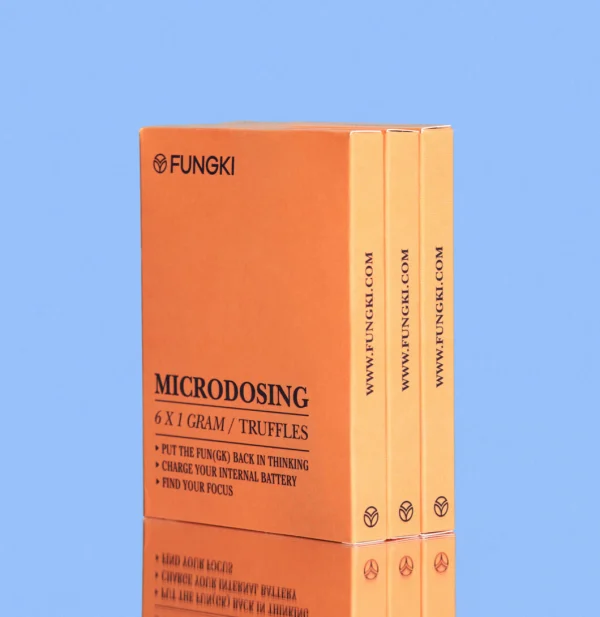
Start with the Beginners Protocol: 18 microdoses of fresh truffles and a fixed schedule of about 8 weeks. With honest information about what we do and don’t know.
Frequently asked questions
Will I feel “high”?
That is not the intention. A microdose is below the threshold at which you experience clear effects. Everyone responds differently, so take your first dose on a quiet day without obligations.
Can I combine it with medication or alcohol?
No. If you take medication, we advise against microdosing. Don’t combine it with alcohol or other substances either.
How many grams is a microdose?
A microdose in our packs is on average 5 small fresh truffles, about 1 gram in total. Because it is a natural product, the weight per dose can vary slightly.
Which protocol should I start with?
Never microdosed before? Then the Beginners Protocol is the logical start: one day a dose, two days of rest, for about 8 weeks.
I live abroad. Can I order legally?
Fresh truffles are legal in the Netherlands, but not in many other countries. Only order if it is allowed where you live. You are responsible for the rules where you live.